Intermission: Competing Editions
Tass Times in Tonetown came out for a frankly outrageous number of systems simultaneously, and when that happens it's always fun to see just what is different between the versions: how they look in general, how they leaned into the power of each system (or didn't), and how they were able to share things across platforms (or weren't).
We'll be using the Jamac Salon as our touchpoint:

Tossing this into IrfanView reveals that 17 colors are in use: 16 colors in the main 320x200 screen and then a distinct border color. 16-color 320x200 is pretty respectable for a 1986 home computer, but it's not pushing the IIgs as hard as it could.
I'm pretty fine with that, to be honest; this was, recall, the
very first game for the platform. It's probably going to be influenced by pre-existing players in the of similar or lesser power.
Which brings us to...
The Atari ST
Chaz is looking mighty familiar here:

16-bit computers basically go all the way back: the TI-99 (1979), the IBM PC (1981) and Macintosh (1984) all had 16-bit CPUs. Nevertheless, I think it makes sense to call the Atari ST (1985) the first "16-bit home computer" because it's the one that brought in the graphics that look like, well, like this. This is the low-resolution 16-color 320x200 graphics mode, and it also had a 4-color 640x200 mode and (with a special monitor) a 640x400 high-res monochrome mode. The 16 colors come from a 4,096-color palette, which is enough that artwork at this level doesn't have a lot of compromises to make.
Also of note is that all its modes were graphical at the hardware level, so text displays were designed from the ground up to fit in the graphics modes. Notice how the text here is "chunkier" than the Apple IIgs ones; the Apple IIs
did have a dedicated text mode and if you wanted text on the graphics screen you were drawing it yourself.
The ST sound chip was relatively weak: a beep-boop chip roughly one tier below the NES and a half-tier at best above the one in the Sega Master System and the Tandy 1000. (No disrespect to those chips either --
you can get very cute with just square waves and noise -- but it's not remotely in the same league as the IIgs or Amiga.)
Tass Times makes decent use of it to provide sound effects, but the implementation is glitchy. The system made a tiny beep whenever you hit a key, and this would shut down the sound systems. In the end, to the extent there was ever any ambient sound it shut off as soon as you hit a key to get past a (MORE) prompt.
All that said, this is an extremely comfy port and the folks who worked on it have nothing to be ashamed of. It's very clearly the hardware this edition of the game was designed for, and it's the bar the others have to clear. The ST didn't expect developers to do anything too crazy with it; it offered respectable capabilities directly at a low price and didn't give too many ways to reliably mess with it for advanced effects.
The Amiga 1000
No, not the Amiga 500 that made the system famous. It's still a year in the future. But the 1000 has functionally identical hardware as far as we are concerned.
Unlike the ST, the Amiga
absolutely expected developers to go all-out in commanding exotic nonsense from its chips. Those of you who remember my
Solaris LP will recall that half of it was about how the Atari 2600 could be made to produce complex displays. The 2600 was unusual because its graphics were so weak that they only knew about a single scanline of the display; the developer would have to update all the graphics state in the handful of microseconds between each line as the beam repositioned. The hidden
strength of this weakness was that the developer was not bound by anything that had happened higher up on the screen; every line was potentially a whole new display, with different sprites or different logic for updating colors or anything the dev could fit in those tens of CPU cycles.
The Amiga's attitude for graphics
agrees entirely with the Atari 2600; it just brings its sensibility into the 16-bit era. This isn't a coincidence: both system's graphics chips were designed by Jay Miner, who clearly had
opinions about how graphics should work.
Programming the Amiga is significantly more sensible than the Atari 2600, though; instead of designing the program to desperately keep up with the display as it is streamed out to the monitor, the Amiga has a dedicated coprocessor (the "Copper chip") which was fed a small program (the "copper list") that was basically a collection of locations on the screen and which graphics settings to alter at each of those points. It also had
many more things it could mess with, so most of the fancy graphics effects available were just a matter of figuring out exactly what to ask it to do and when, rather than figuring out how to be ready to give the data when it was needed.
It was also, beyond that incredible flexibility, modestly more powerful than the ST in terms of its core graphics; it had the same 4,096 color palette, but it could use 32 of them at once instead of just 16, and it also had some sprite capability that we as a text adventure don't really care about here.
Tass Times took advantage of the larger color palette to add a bit more detail and shading:

I'll be honest, I don't really like this; I rather prefer the cleaner lines of the 16-color versions. You can also see that, like the Atari ST, the Amiga is using a chunky system font for its text. That too is a consequence of being a bitmap-only display, I think.
One thing that doesn't show up in the screenshot is that they did try to take advantage of the Copper chip a bit; the swap between full-text and text-and-graphics mode is much faster on this system than on the others. I'm pretty sure they just have a full text screen updated at all times and have the Copper draw its graphics data from different places depending on the current mode. They also tried to be a little sneaky with it and make it smooth-scroll the text instead of scrolling a line at a time like the other systems. Whoever wrote the Amiga version was ambitious.
Unfortunately, their ambition didn't fit their schedule; the text scrolling is
very janky, to the point that I actively missed the line-level scrolling of the other platforms. The Amiga has the best overall sound system of everything in this article, but their music driver clearly had major problems and would take multiple seconds to get any actual playback started, at which point it no longer felt like background music. Even more bizarrely, you will notice we don't have a compass rose or a set of command buttons up there, just a big blank space. That's right: the system that shipped with a Windows-95-class GUI OS in 1985 somehow lacks mouse support. I don't even know what happened there.
In short: even without the source code release that occasioned this LP, I'd still have been playing the Apple IIgs version because it's the one that has the nice color graphics, actually functioning sound from a system that can broadly do SNES-quality audio, and which doesn't require me to play it off of floppy disks.
The Commodore 64
I think the IIgs version is the best version of the game, but this seems to be a minority opinion. Most people prefer the C64 version to any of the others. Going back to the 8-bit world means that we have to make pretty serious compromises in our graphics:

In addition to the illustrations being less fancy (... actually, is that a
Zagtone he's carrying to do our hair with there?) it basically requires proper floppy disk emulation because it relies on a custom filesystem to store all the graphics in a reasonable way. That's an issue
now but wouldn't have been
then; I kind of wonder if it got this reputation because it was much more reliable as a piece of software compared to the Amiga version.
The graphics are dramatically different, though, not merely scaled down like above. The C64's graphics mode is the same 320x200 as we've been seeing above and it allows use of all 16 of its colors at once, as long as you keep the colors a respectable distance apart. You can crowd more colors together, though, if you switch into a 160x200 mode, and that's what
Tass Times does. The text is a little blurry as a result, but they try to make up for it by using the shades of grey in the palette as a sort of antialiasing.
There's often little ambient animations in the screen area in these rooms, but they're quite minimal, probably because the fancier graphics capabilities of the 16-bits meant that they had to restrain themselves a bit to keep themselves fitting on two floppy disks. 8-bit graphics take up much less space, and the C64 animations are more prevalent and more dramatic:

This extends to the intro. Remember how I kind of complained at the beginning that the only intro we got was this excellent dog, and we had no idea what we were doing or why we should care about anything?

It is
significantly more clear in the 8-bit versions that Strange Things Are Afoot At The Circle K.

(Note that Ennio, now Spot because he's back in our world, nevertheless still has his little hat.

)
I'm not completely sure who that is shouting through the warp gate. The hairstyle makes it look like it's Nuyu, but I think we might be supposed to understand this as Gramps being in the process of getting kidnapped. The thing he's shouting is nonsense, though:

"Ennio! Cumen Nuyu!" is the closest I can make out here, which could make sense if he's trying to tell us to get his help. That is what gave us the main quest, after all.
One final note before we move on: there's a mouse pointer on the screen here! Normally this was controlled with the joystick, but Interplay was dead serious about getting mouse support on every platform they could possibly manage. Except the Amiga.
Apple II
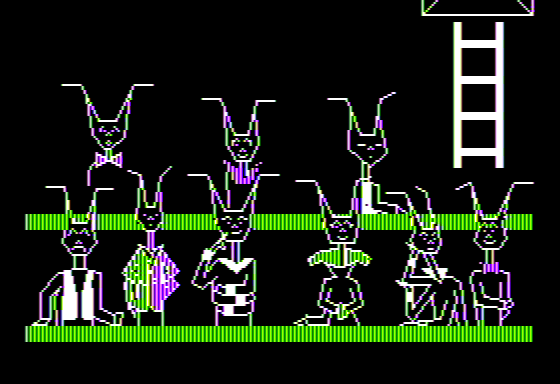
In addition to the IIgs version I'm playing, Burger also did the programming for the C64 and 8-bit Apple II versions. I fired this version up with a bit of trepidation. My last experience with Apple II gaming was pretty crude in the graphics department:
The Apple II has a high-res graphics mode, but it is
absolutely bonkers. The main screen is 280x192 or 140x192 depending on how you count: the same 40 bytes per line that we saw on the C64, but each byte has a palette select bit and 7 color bits. That gets interesting because each colored pixel, to a first approximation, has 2 bits describing its color, which in turn means that each byte in the display is specifying
three and a half pixels. One of them is not only split between bytes, it has an intervening palette-select bit. The palettes also overlap, so the total usable palette is 6 colors, not 8.
These are some rough constraints. Fortunately, Interplay was full of
actual wizards.

One of the other defining features of the classic Apple II display was horrific color fringes and general color noise when not hooked to a monochrome green screen. We see some of that in the text, but only a bit; the graphics end up leaning into it in ways that look like intentional dithering. Beyond this, the Apple II graphics match the C64 graphics quite closely despite being of different resolutions. It's pretty clear they're working off the same designs even though they aren't
identical the way the IIgs and ST versions were.
(Notice also the actual mouse cursor. They programmed multiple mouse drivers into this to make sure you could use it with your pre-Macintosh system.)
Before moving back to 16-bit land, there is one other graphic from the 8-bits I want to bring up:

Ennio in the 16-bit versions gave me J. Jonah Jameson vibes for whatever reason. Here in the 8-bit versions he appears to have a fedora and trenchcoat on a hook. I must assume that he dresses up like Humphrey Bogart whenever he's chasing a story here.
And with that, at long last, back to where we started.
The Apple IIgs
On paper, the IIgs should have been amazing. It came out five years before the SNES, but had the same CPU, running slightly faster than the SNES's CPU usually ran on its launch titles, alongside bitmap mode that was close to but strictly superior to the Atari ST's color modes and a custom sound chip that rivaled the Amiga's and was itself also approximately SNES-class. It also had essentially perfect backwards compatibility, with a more reliable and comfortable version of the 8-bit Apple II's wacky graphics modes (keeping the color bleed but making the edges sharper along the way) and a real sharp text mode that could do 40 and 80 columns with equal aplomb and would run all your BASIC programs three times faster:

It landed two years after the earliest Macintoshes did, and its "GS/OS" operating system did its damnedest to give you something approximating the Mac experience on its own hardware, starting from the initial boot screen...

... to the actual Finder itself.

That said, GS/OS didn't land until 1988, two years after
Tass Times did. If you look at that finder window, you'll see that the
ADVENT.SYSTEM program in the window has a little 8 on the application page. That's indicating that it's an executable written in the format expected by the 8-bit Apple IIs, despite being a fully 16-bit program. A later edition fixed this and made it fully GS/OS native; that's the version that's in Becky's archives. Still, it handles it just fine, with maybe a few wobbles not unlike what you'd get back in the days when you could run DOS games from Windows.
The Finder window here is running in the 4-color 640x200 mode, while the game itself is using the 16-color 320x200 mode. These sound like they're tracking the Atari ST here, but there's an interesting subtlety:
these are actually the same mode. A big part of what differentiated advanced displays on these systems was how you went about changing your graphics modes and configurations mid-screen. The systems we've seen so far offer four strategies, and the IIgs brings in a fifth that I haven't seen in any earlier systems:
- You can just not. This is what the Atari ST does. If you're really insanely clever you can reconfigure things at exactly the right time by deducing where you should be and changing stuff then, but that's basically doing the next technique without any help and with some pretty serious reliability problems.
- You can have the system tell you when it's time to change things. This is how the C64 works. Its graphics chip lets you set a little timer that goes off when the screen display hits a certain line, so you can set your alarm, change your modes as needed, then set the alarm again, and so on.
- You can tell the system in advance what to change and when. That's what a Copper list does, on the Amiga. Basically the C64 approach but backwards.
- The splits are hardcoded options. The mixed graphics/text modes on the 8-bit Apple IIs work like this, with 4 lines of text at the bottom of the screen and the rest graphics. Most illustrated text adventures for that system worked like that; Tass Times is interesting here in part because it uses the whole screen for graphics and manages text completely on its own.
The IIgs approach was to have a little table of 200 entries, one for each line, and each entry in the table specified whether
that specific line was a 320x200 16-color line or a 640x200 4-color line, and also which 16-color palette was the one to use for that line from a selection of 16. The full palette was thus 256 colors out of the same 4,096 the Atari ST and Amiga offered; you just could only use 16 at a time. In addition to all that, in the 4-color modes,
which 4 colors in the 16-color palette varied in a 4-pixel cycle. I'm pretty sure that's why the background of the Finder window has those vertical lines; it's the same 2-bit color value across the screen, it's just auto-dithering based on the palette rotation.
So.
Given
all that, I am doubly unsurprised that Interplay decided to just ignore all that nonsense and provide a near-perfect match of the Atari ST graphics but with a custom text renderer. Even if they could take advantage of the multiple-palette selection, the fact that the command buttons are all on the right edge of the screen would mean that you'd have to keep those colors static on all palettes. It's overall more trouble than it's worth.
Apple internally viewed the IIgs as a threat to its own Macintosh sales and basically strangled the thing in the crib. The only meaningful upgrades it ever got over its whole lifespan were a bit more RAM. The CPU never improved, and even the ST outstripped its graphics capabilities by the end as later models got 32-bit processors and 2D accelerators. It's a pity. The IIgs is a lovely machine on its own terms, but it never got the chance to
exist on its own terms.
Echoes of the Future
There's a kind of funny parallel with the mode-switching stuff once we fast-forward to the early 1990s and the 16-bit era of
game consoles. I described a lot of the IIgs and capabilities as "SNES-class" up above, but the SNES's advanced graphics capabilities were actually very similar to the Amiga's Copper. It had a feature called "HDMA" that was basically a very slightly less fine-grained Copper list (you could only set them at the per-scanline level) but it got more mileage out of it than the Amiga could because the SNES's later-era graphics chip just had more, and cooler, knobs to spin mid-frame. The
Sega Genesis, on the other hand, used hardcoded tables in the Apple IIgs style, supplemented by a C64-like interrupt system for when the tables were insufficient.
A big problem with the IIgs-like table systems is that they're super clean and easy and great if your problem is shaped
exactly like the problem they solve, but otherwise you're completely screwed and have no escape. Sega was wise to retain the C64-style back door.
Sirs Not-Appearing-In-This-Update
The two major ports I didn't look at here are, funnily enough, the ones for the only computers to survive the 1990s: the PC and the Macintosh. There's not a lot to say about either, though.
The Mac version has its own graphics set built around being entirely monochrome and high-resolution.
The PC version is from that
exceptionally awkward era where games were assumed to be run on computers with CGA cards but which were plugged into television sets, where the graphics distortions would reliably turn into a secondary color palette. It also shipped only as self-booting floppy disks with custom filesystems that DOS couldn't read, so Apple ends up reigning supreme here as the
single vendor whose computers could run this game off their damn hard drives. On the flip side, thanks to needing to boot directly into the floppy disk, they developed and shipped their own mouse drivers, because they really,
really seemed to have cared about this.
I also feel a need to underline that every single one of these ports came out basically simultaneously; the gap between the first and last release is
two months. This isn't a case like
Prince of Persia where the ports dribble out over the course of four years. Interplay was
absolutely not fucking around here.
Except for that Amiga port. Seriously. The gap there is so vast I'm not 100% sure my disk images aren't damaged somehow.



 I guess we would like to try again.


 The little smiley face at the end is also a nice touch. (Yeah, it's just the cursor, but still.) Fortunately, this is what quicksaves are for; let's go east now.


 Can you afford not having it? It's not safe out there, you know.
 Having read through the source code, this is actually kind of funny; their underlying engine doesn't have an inventory limit, but it does have a weight limit. They just gave every item in this game a weight of 1, so they never have to worry about overdrawing the inventory window.)


 Now just one moment there, mister.


 tass_4_15_om_nom_nom